
Running a Sex Offender Check in Alabama
The official public source is the Alabama Sex Offender Registry, also called ALEA's Community Information Center. ALEA's CJIS Sex Offender Registry Unit maintains the statewide system. County sheriffs and designated police offices register covered people, verify changes, and send the legally authorized information to ALEA. The public portal is free. It is the correct first stop for a name or location search, while the creating county office remains the source for local verification.
Public coverage is narrower than ALEA's internal registration file. A first conviction for Indecent Exposure or Sexual Misconduct is not posted. Juvenile information is generally withheld unless the court assigns high-risk status. Youthful Offender information is also generally excluded unless the person was over 18 when the offense occurred. Some out-of-state, federal, military, or tribal cases require an Alabama applicability decision. A blank result cannot prove that no registration record exists.
Alabama Registry Records Start Locally
An Alabama registry entry follows a clear path. A local registration office collects and verifies identity, residence, photograph, fingerprints, offense facts, and other required details. That office sends the record to ALEA. ALEA then publishes the subset allowed by the Alabama Sex Offender Registration and Community Notification Act, known as ASORCNA. The online profile and the local registration file are related, but they are not identical.
Record flow: County Registration › Local Verification › ALEA Registry Unit › Public Profile
A stale address should be reported to the sheriff or designated police office that registered it. Do not visit the address. If the local agency confirms a correction but the public display remains wrong, contact ALEA's Sex Offender Registry Unit. The Alabama county directory routes readers to all 67 local records sites and their official agency channels.
Note: A public map pin shows a submitted location; it does not prove current presence or replace local verification.
How to Search the Alabama Sex Offender Registry
Start from ALEA's registry information page so a vendor URL change does not break the route. Alabama law requires search capability by name, city or town, county, ZIP Code, and geographic radius. Exact labels may change. The controls remain tools for finding official profiles, not proof that a person is at a mapped place now.
- Open the ALEA-linked public registry and choose a name or location search.
- Try legal names and known aliases. For area awareness, use the county, city, ZIP, or address-based radius mode.
- Open a result and compare the photograph, age details, physical description, aliases, and conviction facts.
- Read the address type, update context, and compliance status. Contact the registering agency about a factual problem.
| Field or Mode | Type | Required | Alabama Search Notes |
|---|---|---|---|
| Name | Text search | Mode dependent | Required by Ala. Code §15-20A-8; use aliases when known |
| City or Town | Text or selection | Mode dependent | Finds public profiles tied to a place |
| County | Selection | Mode dependent | Supports statewide coverage across Alabama counties |
| ZIP Code | Text | Mode dependent | Five-digit geographic search capability |
| Geographic Radius | Address and distance | Address for radius mode | Creates a mapped-area search; choices may change |
| Map or List | View control | No | Compare the profile with the pin rather than trusting the pin alone |
No Alabama Registry Result
No result has several possible meanings. The spelling or alias may differ. A new local update may not yet appear. The record may fall within a public-list exclusion. An out-of-state conviction may still be under ALEA review. The person may also have moved across a state line. Search variations carefully before drawing a conclusion.
For a cross-state check, use the U.S. Department of Justice National Sex Offender Public Website. NSOPW brings together participating jurisdictions, but it does not replace Alabama's registry for an Alabama address or correction. Confirm an Alabama profile through the local registering office. Never treat silence in one system as a certificate that no covered history exists.
Note: A spelling variant, public-list exclusion, recent move, or pending applicability review can explain an empty Alabama result.
Inside a Registry Profile
Alabama law identifies the public fields that may appear. A profile can show a current photograph, legal name, aliases, physical description, actual or last-known residential address, permitted work or school facts, vehicle details, qualifying conviction information, and a reported compliance status. Read every field in context. An alias is an identifier, not proof of current use. An absconded label is a reported status, not permission for a private search.
| Name & Aliases | Legal name plus known former names and aliases used to distinguish records. |
|---|---|
| Photograph & Description | Current submitted image with age or birth information and physical traits. |
| Registered Address | Actual or last-known residence; homeless registration follows separate rules. |
| Work, School & Vehicles | Publicly authorized location and vehicle identifiers when applicable. |
| Conviction Details | Qualifying offense, jurisdiction, and conviction context, not the full case file. |
| Compliance Status | The status reported through the registration system, including absconded where shown. |
Victim identity, Social Security numbers, non-conviction arrest history, private online identifiers, and travel-document numbers are not public profile fields. The registry also omits the full evidence and court docket. Use the originating court when a conviction document is needed.
ALEA Alabama Registry Materials
The ALEA registry FAQ and contact page identifies public coverage, exclusions, update duties, and the route to the statewide search.
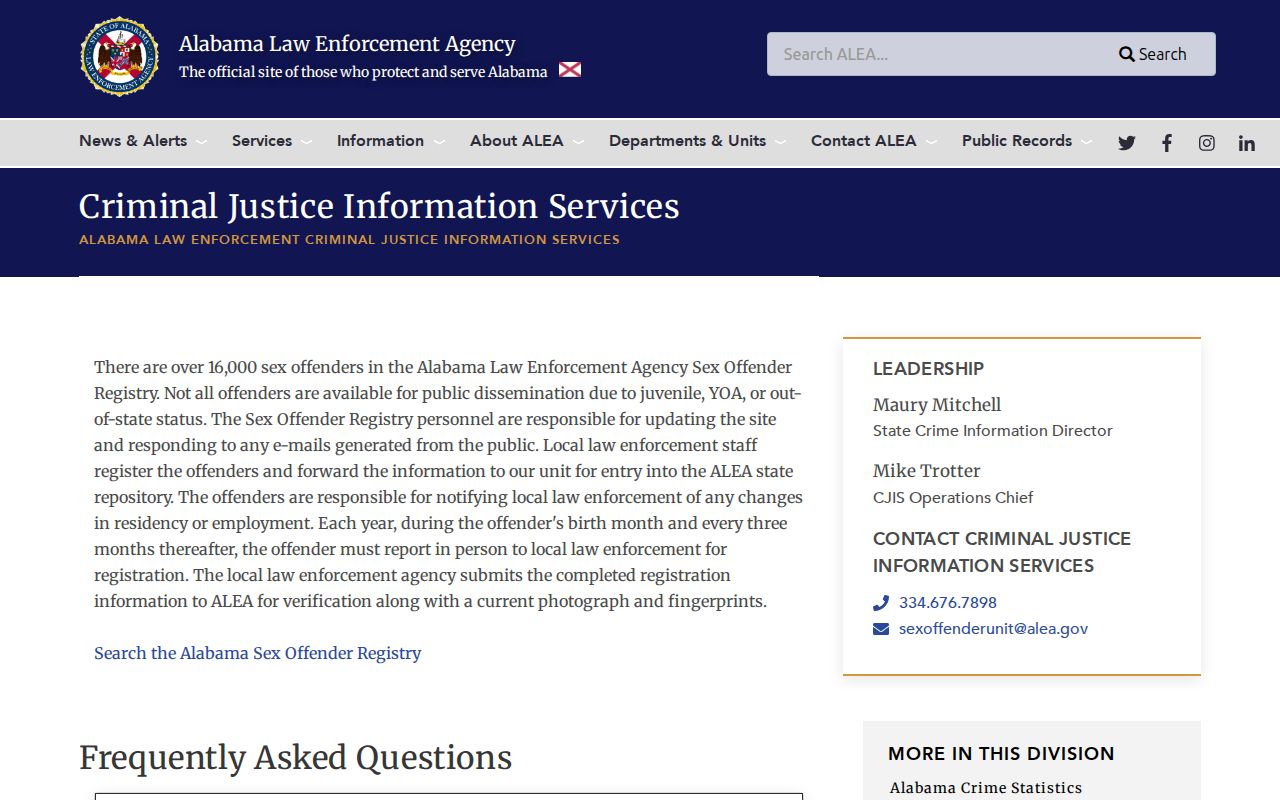
That split matters. ALEA publishes the statewide view, while a county sheriff or designated police office supplies and verifies the local facts. The FAQ is also the safer entry point when the hosted search address changes.
ALEA separately provides an official responsibilities and forms hub for adult, juvenile, travel, homeless, and out-of-state situations.
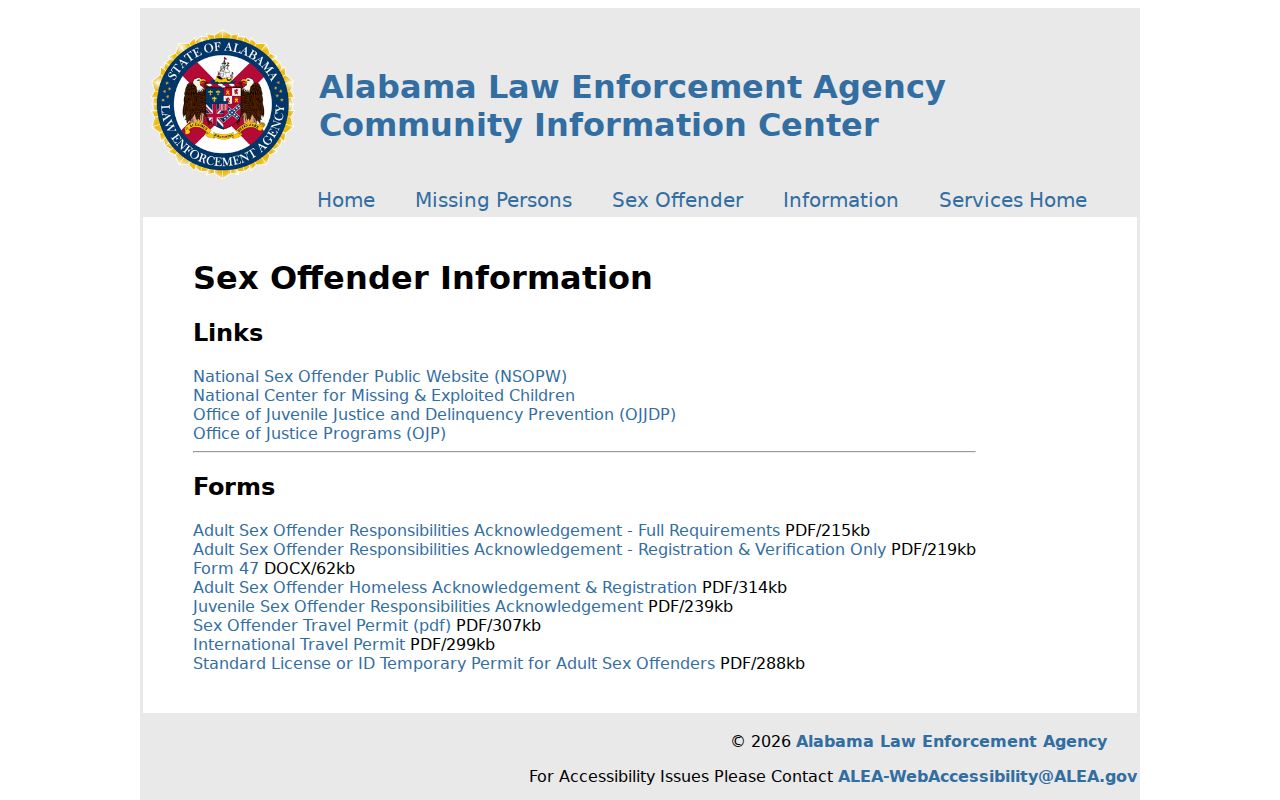
The catalog includes acknowledgments and permits for distinct legal settings. A registering office should identify the current form. Readers should not assume an adult form, juvenile acknowledgment, travel permit, or out-of-state review applies to every person.
Alabama Registration Requirements and Levels
Alabama does not use the federal adult Tier I, II, and III duration ladder as its public state scheme. The ordinary adult ASORCNA rule is lifetime registration, with in-person verification during the birth month and every three months after that. Juvenile duration and publicity depend on different statutes and a sentencing-court risk decision. A searcher should not infer an adult tier from another state's label.
| Alabama Category | Duration | Verification or Publicity |
|---|---|---|
| Adult subject to ASORCNA | Life | In person in birth month and every three months; public when dissemination rules apply |
| First Indecent Exposure or Sexual Misconduct conviction | As the statute directs | ALEA says the first conviction is not placed on the public site |
| Juvenile age 14 or older, enumerated serious offense | Life, with possible petition after 25 years | Court assigns notice level; high-risk status may be public |
| Other covered juvenile | 10 years from first registration | Low or moderate notice is limited; high risk may be public |
Initial registration occurs in each relevant county for residence, work or volunteer activity, and school. A change can trigger immediate reporting in the old and new jurisdictions. The adult verifies in every county of residence. Knowing failure to perform duties under Ala. Code §15-20A-10 can be a Class C felony.
Note: Alabama juvenile risk levels govern notice and duration differently from the ordinary adult lifetime registration rule.
Alabama Registry Radius Versus Law
The portal's radius is a search setting. It is not Alabama's legal residence measurement. Under Ala. Code §15-20A-11, an adult generally may not reside within 2,000 feet of specified schools, childcare facilities, resident camps, or a former victim and immediate family, subject to statutory details and exceptions. The distance runs in a straight line from the nearest property line to the nearest property line.
Map distinction. A user-selected registry radius finds profiles near an address. It cannot decide whether a residence complies with Alabama's property-line rule.
Community notification also follows a separate government process. In Birmingham, Mobile, Huntsville, and Montgomery, the police chief has specific distance-based notice duties under §15-20A-21. Elsewhere, sheriff and police responsibilities depend on location. A self-directed map search does not replace formal notice, and ALEA does not assign a person-specific dangerousness score.
Correcting an Alabama Registry Address
When an address or status appears wrong, save the official profile URL and the date viewed. Call the local registering sheriff or police office. State the factual discrepancy and ask the agency to verify its submission. Allow the local-to-ALEA update chain to work. If a verified correction still does not appear, contact the ALEA Sex Offender Registry Unit at 334-676-7898 or sexoffenderunit@alea.gov.
Suspected noncompliance should also go to law enforcement. Do not follow, confront, photograph, or publish extra details about a listed person. An Alabama registry profile supports awareness and official reporting. It does not grant investigative authority to the public.
Note: For a move from another state, ALEA may need a Form 47 applicability and due-process review.
Lawful Use of Registry Data
Use Alabama registry data for personal, family, neighborhood, and community awareness. Confirm identity from the full profile. Report suspected violations to law enforcement. Do not infer current danger from a conviction-based listing or amplify personal details. The Community Information Center states that the registry is not a substitute for formal notification and does not reflect an individualized ALEA risk decision.
Registry misuse warning. Ala. Code §15-20A-8 warns that public registry information may not be used to unlawfully injure, harass, or commit a crime against a listed person. Misuse can bring civil or criminal consequences. Use the record for awareness and official reporting, never retaliation or vigilantism.
Alabama recorded 11,319 active registry records, 9,452 public-notification cases, and 170 absconded cases at the end of FY2023. These figures describe different groups and must not be added together. They reinforce the central distinction: an internal active record, a public profile, and a compliance category are not the same thing.