
Criminal Court Cases in Alabama
Alabama uses several courts for criminal records. Municipal Court hears municipal-ordinance and authorized local matters. District Court jurisdiction covers most misdemeanors, felony preliminary hearings, and certain noncapital felony pleas. Circuit Court has general jurisdiction and receives felony prosecutions after indictment. The Alabama Court of Criminal Appeals reviews criminal appeals and post-conviction writs. The Alabama Supreme Court provides the highest state review where authorized.
Each county circuit clerk keeps both Circuit and District Court files. Municipal courts remain separate. That split matters because an Alabama court case lookup aimed only at a Circuit docket can miss a municipal case or an early District proceeding. Appeals form another record stream. The free appellate portal guide lists case number, title, category, and filed date. Trial files and appellate records should be searched as distinct parts of one case history.
| Court | Criminal role | Next review |
|---|---|---|
| Municipal Court | Municipal offenses | Circuit Court trial de novo |
| District Court | Most misdemeanors and felony preliminary stages | Circuit Court trial de novo |
| Circuit Court | Felony and joined or indicted lesser offenses | Court of Criminal Appeals |
| Appellate courts | Criminal appeals and authorized review | Final state review |
Alabama Criminal Jurisdiction Splits
A felony complaint can start in Alabama District Court, where the early record may include an initial appearance and a preliminary hearing demand. An indictment generally moves the prosecution into Circuit Court. This is not a duplicate case by mistake. It reflects the route set by Alabama procedure. A misdemeanor usually stays in District Court unless municipal jurisdiction or another exception applies.
Municipal cases create a common search gap. Just One Look advertises Alabama Circuit and District trial records, not complete municipal coverage. When a city matter does not appear, contact that municipal clerk. A municipal conviction appealed for a new trial can create both a municipal origin and a Circuit appeal record. The correct search follows both court levels instead of treating one missing remote result as proof that no case exists.
Note: Court jurisdiction identifies the record keeper; it does not show whether a charge ended in conviction, dismissal, or acquittal.
Searching Alabama Just One Look
Alabama Just One Look provides paid remote access to advertised Circuit and District trial records. It offers name and case-number modes. Registration and payment gate the full search forms, so fields beyond the documented landing page and account form should not be assumed. A name search costs $9.99 and includes one detail; a no-match name result is still charged. A case-number search also costs $9.99 with one detail included.
- Identify whether the matter belongs in Circuit, District, or Municipal Court.
- Use a known case number when possible; otherwise search the person’s name and allow for aliases.
- Review the case detail, status, actions, settings, and financial history before buying images.
- Check a municipal clerk separately when the charge arose under a city ordinance.
- Verify the outcome and request certified documents from the filing county’s circuit clerk.
| Field or mode | Type | Required | Notes |
|---|---|---|---|
| Name search | Paid search mode | One mode required | Official public landing page confirms name search |
| Case number | Paid search mode | One mode required | Best when copied from a clerk or filing |
| Account text field | Yes | Entered and confirmed during registration | |
| Name and address | Account text fields | Yes | Includes city, state, ZIP, and phone |
| Terms acceptance | Checkbox | Yes | Required to create an account |
The official trial-record landing page shows the paid name and case-number choices available to an Alabama criminal case searcher.
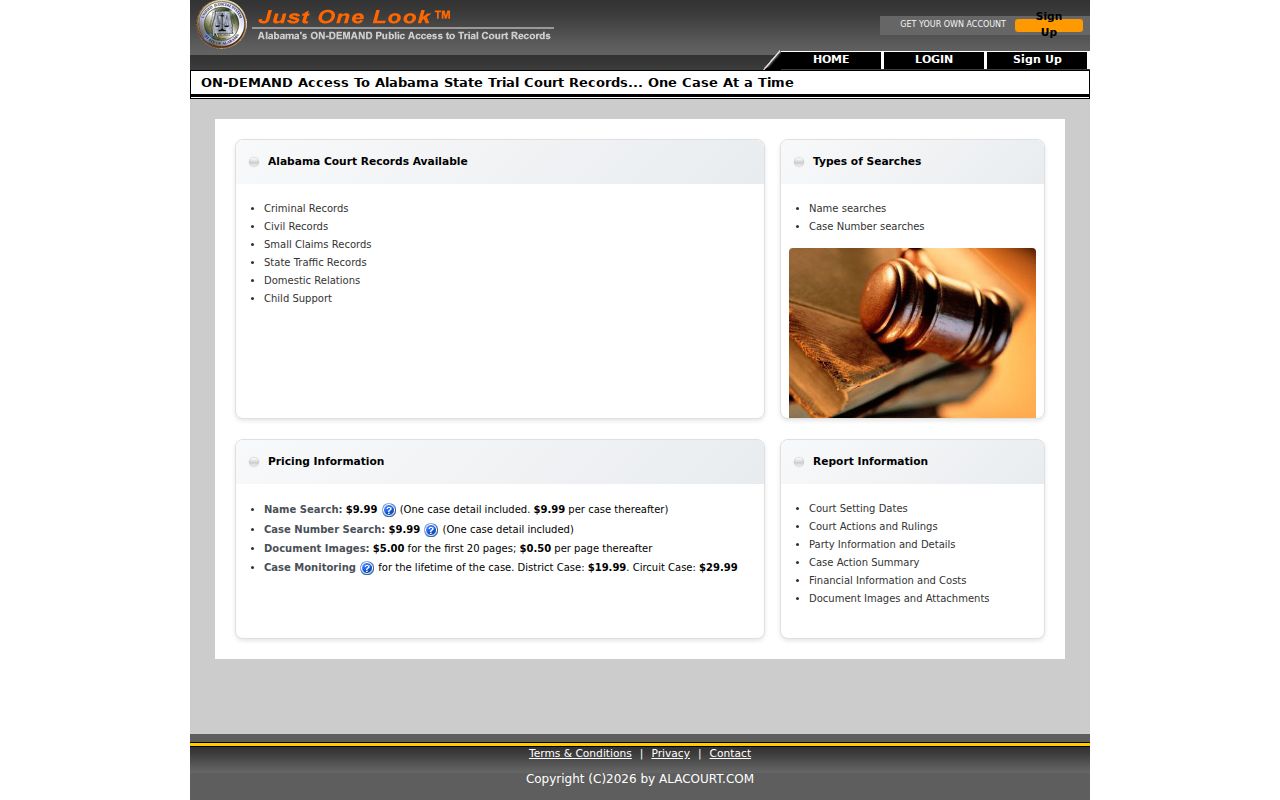
The interface confirms that remote convenience is sold one search at a time, while the underlying clerk record remains the source to verify.
Note: A no-match Just One Look name search is still chargeable, so verify spelling and venue before paying.
Paid Alabama Case Search Limits
Just One Look advertises basic case information, court actions and rulings, status, settings, parties, financial history, a detailed case-action summary, and purchased attachments. Images cost $5 for the first 20 pages and $0.50 for each added page. Purchased snapshots remain in customer history for at least 30 days and show the view date. Monitoring costs differ by District or Circuit case, and the portal treats monitoring as complete 42 days after a court-action date.
The signup screen is useful because it shows an access gate, not an open government name index. The Just One Look account source displays the identity, address, telephone, password, and terms fields needed before paid use.
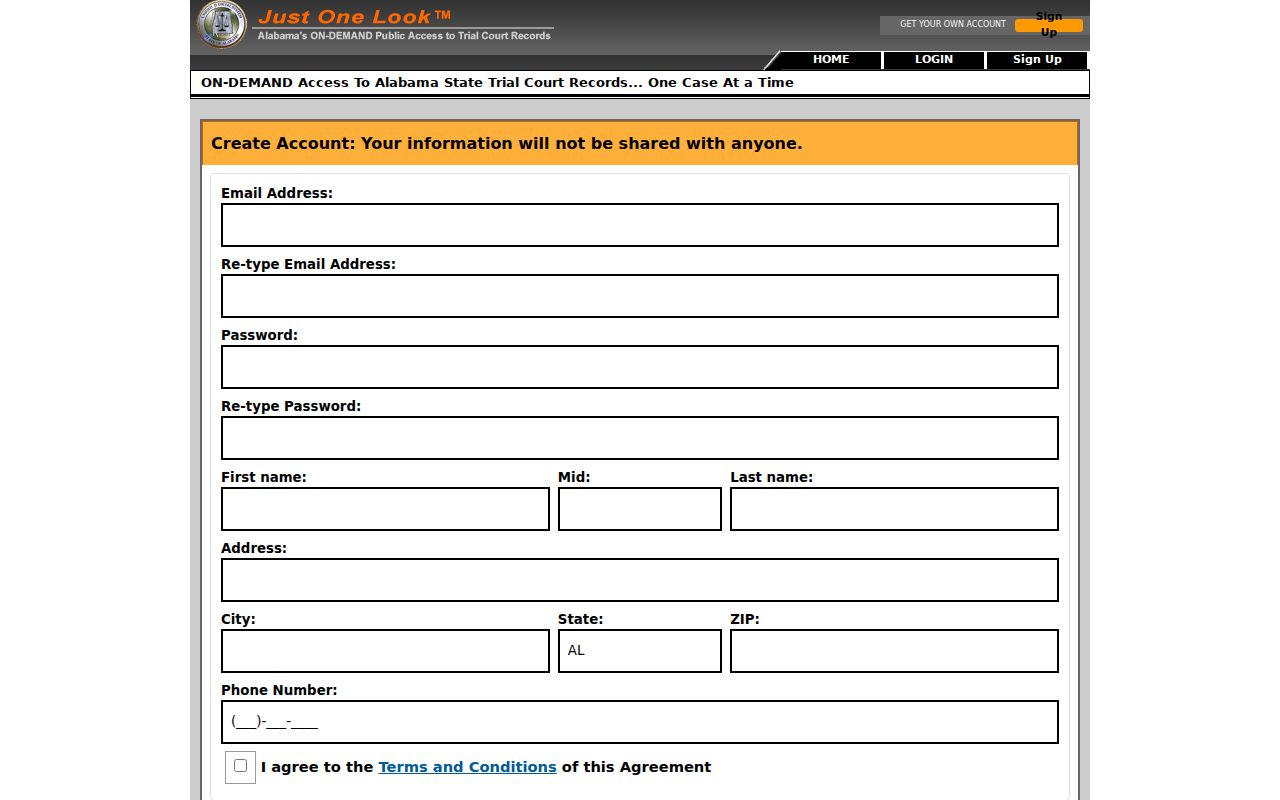
Those account fields explain why a casual remote Alabama court record check stops before the transaction screen. They do not reveal undisclosed post-login search filters.
Inside an Alabama Criminal Case File
An Alabama criminal case file documents one prosecution. It can include the complaint, warrant and return, indictment, appearance and bond papers, counsel appearances, motions, scheduling orders, plea forms, verdict, judgment, sentence, probation order, financial assessment, revocation filings, and appeal notice. Discovery notices may appear without the police evidence itself. The arresting agency remains the source for its investigative report.
| Case Number & Court | Identifies the prosecution, filing court, and county record keeper. |
|---|---|
| Charging Documents | Shows the complaint, information, or indictment and the filed allegations. |
| Docket Entries | Lists court actions, filings, settings, rulings, and case status changes. |
| Hearing Dates | Records scheduled and completed appearances, subject to later changes. |
| Disposition | States the outcome, which may be dismissal, nolle prosequi, acquittal, plea, or verdict. |
| Sentence & Judgment | Shows the final judgment and any confinement, probation, fine, restitution, or conditions. |
This court file is not an ALEA rap sheet. ALEA compiles fingerprint-linked arrest cycles and reported outcomes across Alabama. A clerk file preserves the original papers and action history for one case. If the two disagree, obtain the certified court outcome and use ALEA’s own-record challenge channel rather than assuming either display is current.
Free Alabama Court Record Viewing
Remote payment does not decide whether an Alabama court record is public. Under the Court-Record Privacy and Confidentiality Rules, Rule 401 permits free public viewing of District and Circuit electronic dockets and records at the clerk counter during business hours. Subscriber remote access is a separate service. A person can therefore inspect a public record locally even when paid Just One Look is not the best route.
Rule 33 gives the Administrative Office of Courts control over compiled electronic data, images, and databases. A request for a large data extract can require approval, programming work, cost, and use limits. That process differs from viewing one public case at its clerk’s office. Alabama’s 2025 privacy rules also redact Social Security, taxpayer, and account identifiers to the last four digits and protect sealed or confidential matter.
Juvenile records, Youthful Offender matters, protected victim or minor information, expunged cases, and sealed material are not made public by paying a portal fee. If a public document image is missing, request it from the clerk. If the law restricts the document, switching access methods does not remove that restriction.
Note: Free clerk-counter viewing applies to public Circuit and District records, not material made confidential by law or court order.
How an Alabama Criminal Case Moves
An Alabama case may begin with an arrest or summons, followed by a complaint and early court review. Criminal Rule 4.3 requires a probable-cause decision after a warrantless arrest without undue delay and no later than 48 hours. The initial appearance addresses identity, charges, rights, counsel, and release. A felony complaint can then move through a demanded preliminary hearing and grand-jury action before Circuit Court arraignment.
Case flow: Charges Filed › Arraignment › Pretrial › Plea or Trial › Disposition › Sentencing
“Pending” means no final disposition is recorded. “Disposed” means an outcome exists, but the judgment or case-action entry must still be read. A dismissal or nolle prosequi is not a conviction. An acquittal is a not-guilty decision. Bond terms concern release before final judgment, not guilt. Financial history can mix court costs, fines, restitution, and payments.
- Disposition
- The recorded result or status of a charge or case.
- Nolle prosequi
- A prosecutor’s decision not to proceed at that time, not a finding of guilt.
- Capias
- A court process directing custody, often after a failure to appear or default.
- Indictment
- A grand-jury accusation that generally routes felony prosecution into Circuit Court.
Alabama Criminal Specialty Court Paths
Alabama’s Administrative Office of Courts publishes statewide information for accountability courts, including adult and family drug courts, mental-health courts, and veterans courts. These are structured court programs, but the statewide maps do not mean that every program is offered in every county. Participation, eligibility, and the docket entries generated by a program must be confirmed with the court handling the case.
The Alabama accountability-court source maps program availability across the state.
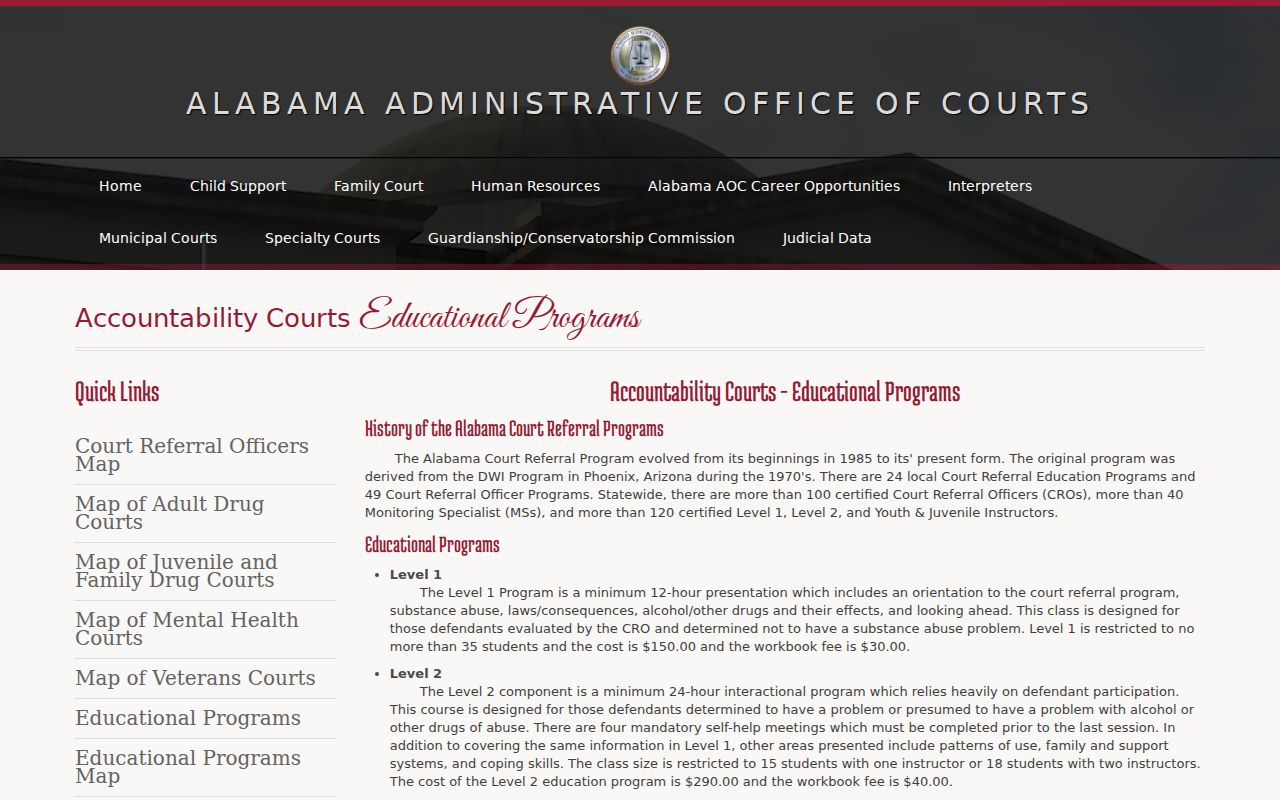
The maps help route a program question, while the individual Alabama criminal court case file remains the place to confirm an order, status, or disposition.
Reading Alabama Criminal Case Outcomes
A case-action summary must be read in sequence. A booking charge can change when a complaint is filed, a grand jury returns an indictment, or a prosecutor amends or dismisses a count. “Cleared by arrest” is a police reporting status, not a court judgment. Likewise, a warrant or capias entry shows a court action, not guilt on the underlying allegation.
Check the charge-level result. One count can end in conviction while another is dismissed. Then read the judgment and sentence. When the court outcome is absent from an ALEA own-record review, obtain a certified disposition or case-action summary from the clerk. ALEA’s challenge process can route source evidence to the originating agency and correct or supplement repository data. That process fixes inaccurate information; it does not grant expungement.
Note: A court outcome should be matched by case number and charge, not merely by a similar name in a paid result.
Case Records at the County Level
The full Alabama case file sits with the clerk where the prosecution was filed. That office can provide counter inspection, paper copies, certified copies, and archive searches for older or non-imaged files. A useful request identifies the case number if known, party name and aliases, approximate year, date of birth, charge, court level, desired documents, certification need, and delivery method. Copy, certification, postage, and archive charges vary locally.
County routing is especially important where one county has more than one courthouse location, and it prevents requests from going to an office that never held the case. Open the directory of all 67 Alabama counties to find the county criminal-record site, then confirm the Circuit, District, or municipal custodian. This source-level check is the best way to distinguish a missing online image from a missing case.
The county court file and ALEA criminal history answer different questions. Use the clerk for the filed charge, motions, judgment, and certified outcome. Use ALEA’s fingerprint-based self-review for a multi-county statewide rap sheet. Neither product replaces the other.