
What the Alabama Law Enforcement Agency Is
The Alabama Law Enforcement Agency is the parent public-safety agency. Its State Bureau of Investigation is the non-uniform investigative component. Within SBI, the Criminal Justice Information Services Division operates Alabama's criminal-history functions. The Criminal Records Identification Unit maintains fingerprint files for arrested people and the computerized state Criminal History Repository. Calling the repository simply a state police database misses that structure.
The Records Check Section responds to lawful record inquiries and dissemination requests. The Criminal History Section maintains the fingerprint-backed history and works on accuracy. Automated Fingerprint Identification Services processes and retrieves biometric records through the modern Automated Biometric Identification System, or ABIS. ALEA also serves as Alabama's FBI CJIS Systems Agency and NLETS System Agency.
Inside ALEA SBI CJIS
ALEA CJIS houses several units that share secure infrastructure but publish different products. Criminal Records Identification maintains the repository. The Sex Offender Registry Unit maintains the statewide registry. Incident Reporting runs Alabama's UCR and NIBRS statistical stream. Compliance audits participating systems and agencies. The Latent Print Unit supports biometric identification in investigations. One CJIS division does not mean all of its files are one public database.
The official ALEA CJIS division page shows the division's units and statewide contact structure.
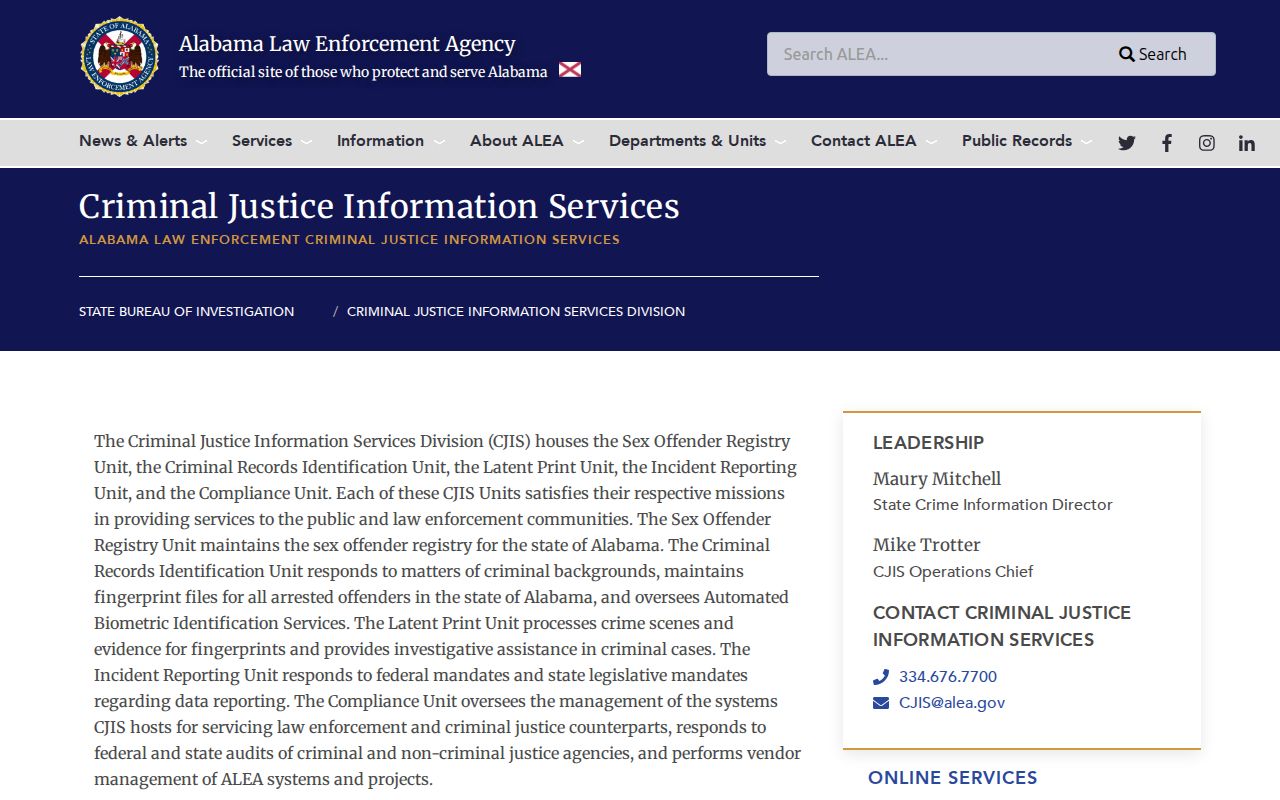
For repository questions, the Criminal Records and Identification Unit can be reached at 334-676-7897 or 1-866-740-4762. The CJIS division's general line is 334-676-7700. Those contacts are appropriate for ALEA process questions, while a county clerk or arresting agency remains responsible for its originating facts.
Note: ALEA CJIS units share infrastructure, but criminal history, registry, statistics, compliance, and latent-print records remain distinct products.
ALEA Criminal History Check Options
ALEA does not offer an unrestricted public name-only repository search. The public personal route is a fingerprint-based Application to Review Alabama Criminal History Record Information, commonly called SBI Form 46. The Alabama Background Check system, or ABC, is a secure subscriber service for qualifying access. Court searches through Just One Look are separate AOC products and do not return an ALEA rap sheet.
Alabama criminal-history record information is controlled rather than generally open under the Public Records Law. Rule 265-X-2-.02 governs lawful dissemination and does not allow confirmation to an ineligible requester. False-pretense access, unauthorized communication, or falsification can carry the penalties in Ala. Code §41-9-601. The subject-review process is the lawful public route for an individual checking their own file.
| Product | Who May Order | What It Returns | Cost |
|---|---|---|---|
| ALEA Form 46 review | The subject of the record | That person's Alabama CHRI for review or challenge | $25 |
| Additional Form 46 copy | The same requester with the packet | Another copy of the response | $5 |
| Challenge within one year | The subject with the ALEA response and source proof | Research and a correction determination | No separate challenge fee stated |
| Current ABC report | Qualifying subscriber or account | Name-based Alabama repository report subject to matching limits | Public amount not posted |
| Authorized state or national check | An authorized program using its official route | Alabama and, when law permits, FBI information | Varies by program |
A local authorized law-enforcement agency may charge separately to capture fingerprints. ALEA publishes no single statewide capture price and names no universal retail vendor for personal review. Call ahead to confirm that an office has an FBI-issued ORI and can provide the approved applicant card or AFIS printout.
ALEA Repository Authority and History
Alabama created the Criminal Justice Information Center Commission in 1975 to establish statewide and interstate information services. ALEA itself came from Act 2013-67. Operational consolidation took effect in 2015, when ACJIC operations moved into ALEA SBI CJIS. The independent Alabama Justice Information Commission retained its policy and rule role. The official AJIC history documents that division.
Ala. Code §41-9-652(b) designates ALEA as the repository for criminal-history compact purposes. Technology changed while that local-to-state model stayed intact. Alabama moved from accumulated fingerprint cards toward AFIS and then ABIS. The NGI-connected biometric system went live in 2021. A 2022 modernization project sought stronger disaster recovery, event updates, record-quality reports, disposition backfill, and future Rap Back support.
Note: AJIC sets policy and rules while ALEA SBI CJIS performs the repository's daily criminal-history operations.
How Records Reach ALEA
An Alabama criminal history begins with a source event. A municipal police department, county sheriff, ALEA trooper, campus officer, or another authorized agency makes an arrest and creates its report. At booking, the custodian records identifying information, a photograph, charges, bond, and fingerprints. State law requires designated arrest identifiers and biometric information to move into the criminal-justice information network.
Data flow: County Booking › Fingerprint Submission › ALEA ABIS › County Court Disposition › ALEA Rap Sheet
Courts create a different stream. Alabama District Courts handle misdemeanors and early felony stages. Circuit Courts hear indicted felonies. Municipal courts keep city matters. Courts and criminal-justice agencies report qualifying outcomes, which ALEA must match to an arrest cycle. A booking record, case file, and repository history remain separate products even after the data is linked.
Ala. Code §41-9-625 also requires a state, county, or municipal criminal-justice agency to report within 30 days when a person is released without charge or cleared so qualifying information can be removed. That rule is not a universal deadline for every conviction disposition.
Note: The statutory 30-day clearance rule does not set one deadline for every Alabama conviction disposition.
ALEA Form 46 Field by Field
SBI Form 46 ties a request to identity facts and fingerprints. The form asks for legal and former names, sex, race, date of birth, Social Security number, address, telephone numbers, driver license information, and applicant signature. It also carries witness or notary paths. ALEA uses internal transaction and Alabama SID fields to manage identity and repository work.
| Identity | First, middle, last, suffix, aliases, maiden names, date of birth, sex, and race. |
|---|---|
| Contact | Current address plus home, mobile, and work telephone lines. |
| Identification | Driver license details, accepted photo-ID copy, and applicant fingerprint card. |
| Authorization | Applicant signature and date with either two witnesses or a notary block. |
| Attachments | Completed form, photo ID, fingerprints, and fee instrument. |
| Challenge Detail | Contested charge, date, agency or court, claimed error, proposed correction, and source proof. |
The direct file name and internal revision markings are not perfectly aligned. Use ALEA's current hosted copy. Follow the payee language printed on that packet, and call the unit before submission if the payment or walk-in instructions appear to have changed.
Ordering a Check From ALEA
The official ALEA Alabama Background Check page separates personal review from restricted ABC access.
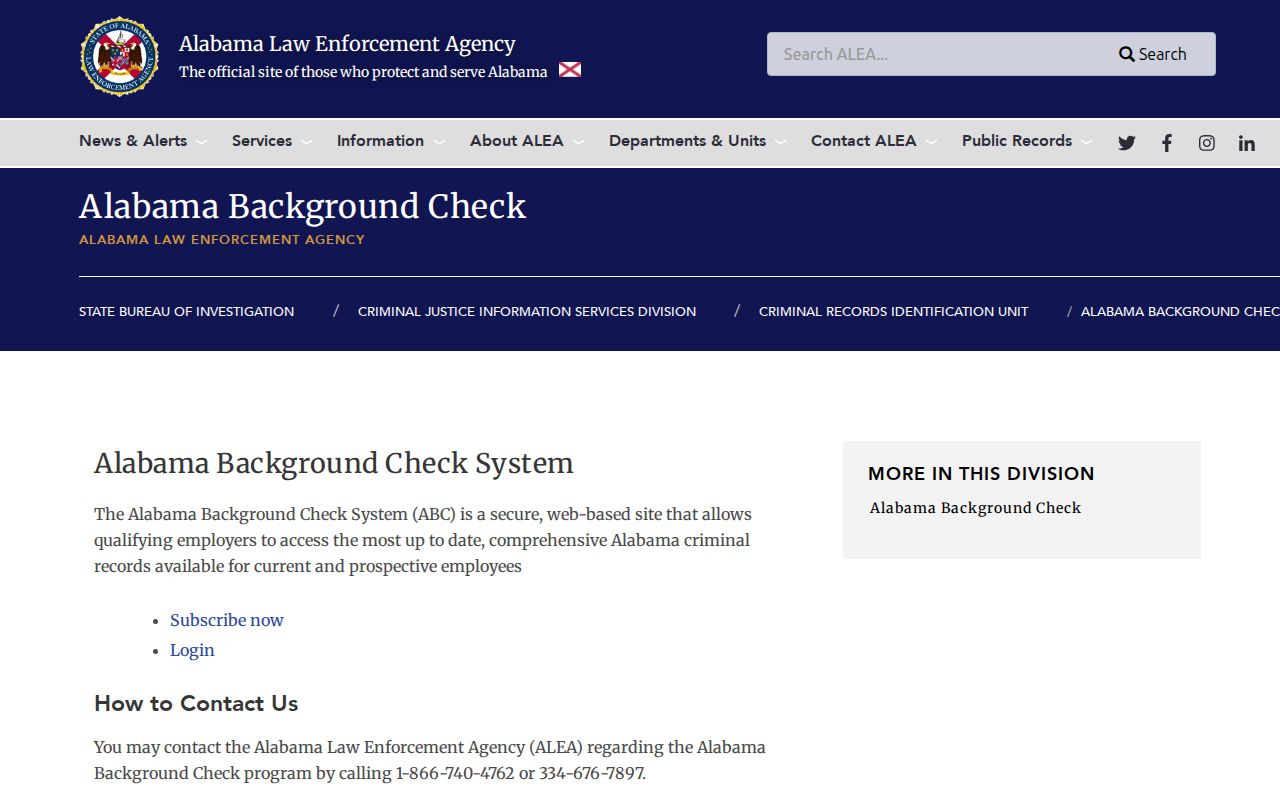
The visible ABC link does not make the repository an open people search. For personal review, use the fingerprint packet and plan for ALEA's stated minimum processing period.
- Download the current Form 46 packet from ALEA and read its identification and payment instructions.
- Arrange fingerprints with an authorized law-enforcement agency that has an FBI ORI. Confirm its fee and hours.
- Complete the form, attach one accepted current photo-ID copy, and sign through the witness or notary path.
- Add a $25 cashier's check or money order. Mail or hand-deliver the packet to the Criminal Records and Identification Unit.
- Allow at least four to five weeks. Compare the response with original court documents before disputing an entry.
Mail goes to Criminal Records and Identification Unit, ATTN: Background Checks, P.O. Box 1511, Montgomery, AL 36102-1511. Walk-in delivery is at 301 South Ripley Street on the Adams Avenue side. The addresses identify the statewide agency, not a local fingerprint service.
ALEA Fingerprints Versus ABC Names
Fingerprint review and name matching answer different identity questions. Form 46 ties the subject to biometric data and is ALEA's public route for reviewing one's own repository history. ABC uses names and identifiers for authorized subscribers. Alabama's rules warn that a name result may belong to another person, while a no-record response may miss history associated with different identifiers.
| Channel | Identity Basis | Best Official Use | Main Limit |
|---|---|---|---|
| ALEA Form 46 | Fingerprints and photo ID | Review or correct one's Alabama CHRI | Packet process and four-to-five-week minimum |
| ALEA ABC | Name and identifiers | Authorized repository inquiry | Restricted access and name-match risk |
| Just One Look | Party name or case number | Find a filed Circuit or District Court case | Not a rap sheet; fee and coverage limits |
| County Clerk | Case and party facts | Get the original disposition or certified file | One local court system at a time |
Fingerprints improve identity matching. They do not create a missing source record or fill a court file. A recent arrest can reach a jail roster before ALEA. A dismissal can appear in the clerk file before ALEA receives or matches the outcome.
Note: A fingerprint match strengthens identity, but completeness still depends on the agency and court records submitted to ALEA.
County Records vs ALEA Checks
An ALEA review compiles fingerprint-linked Alabama criminal-history events received by the repository. The county keeps the source files: arrest reports, jail events, charging papers, docket entries, orders, and certified dispositions. Neither source replaces the other. Use ALEA to see how statewide history is compiled. Use the Alabama county directory when the actual court or arrest document is needed.
| Question | ALEA Check | County Record |
|---|---|---|
| Coverage | Reported fingerprint-linked history across Alabama | One county's creating agencies and courts |
| Source | Central repository entries | Original booking, report, docket, and order |
| Freshness | Depends on submission and matching | Changes as the local event or case moves |
| Detail | Compiled arrest and disposition lines | Filings, action history, evidence access rules, and certified copies |
| Best Use | Own statewide record review | Confirm one event and supply correction proof |
The AOC Just One Look service is another layer. It provides paid Circuit and District trial-court information, but it is not ALEA criminal history. Municipal cases, restricted files, and local archives can still require a direct clerk request.
ALEA Workload and Record Gaps
ALEA's FY2025 report says ABIS processed 391,342 fingerprint cards. That total included 292,222 arrest cards, 672 sex-offender cards, and 99,120 applicant background-check cards. The repository also received 52,872 dispositions, processed 1,587 Circuit Court expungement requests, and processed 756 pardons from the Alabama Bureau of Pardons and Paroles. These are work transactions, not counts of unique people.
Prior annual reports document why source checks matter. In FY2021, CJIS could not complete 209 expungement orders because arresting agencies had not submitted fingerprint cards. The FY2022 total was 470. A missing card, delayed submission, rejected record, or unmatched disposition can cause a repository result to disagree with the court. Modern biometric software can match submitted facts; it cannot invent a source event that never arrived.
Completeness check. When an ALEA disposition appears missing or wrong, obtain certified proof from the court or arresting agency that created the event.
Note: ALEA workload totals count transactions and processing events, not unique people with Alabama criminal histories.
Fixing Errors in an ALEA Record
Alabama gives the record subject a formal review and challenge route. Start with Form 46. Appendix A requires the challenged charge and arrest or disposition date, the responsible agency or court, the exact disputed information, the proposed correction, and the source for that claim. Attach the ALEA response and official records when available. ALEA then contacts the originator because the originator must verify its own facts.
- Order your fingerprint-based ALEA record and mark each disputed arrest or disposition.
- Obtain the original order, disposition, or arrest document from the responsible court or agency.
- Complete Appendix A, attach the ALEA response and source proof, and mail it marked ATTN: Record Challenge.
- Review ALEA's written determination. If needed, use the administrative appeal path in Rule 265-X-2-.03.
A challenge filed within one year of the ALEA response has no separate fee stated. After one year, begin with a new $25 review. ALEA does not promise the original four-to-five-week timeline for a challenge because another agency may need to research the claim. Expungement is a separate court process, not a substitute for correcting a factual error.
ALEA Changes After October 2026
Act 2026-374 takes effect October 1, 2026. It revises the Alabama Background Check Service and authorizes an Alabama Rap Back framework. The law permits ALEA to set a report fee up to $30, plus allowed FBI, transaction, registration, and convenience costs. A Rap Back annual fee may not exceed $12 for an enrolled person. Those figures are ceilings, not proof of final live prices.
Rap Back uses retained fingerprints so authorized participating entities can receive later criminal-history updates. It is not a public person alert. Participation requires notice about fingerprint retention, and an authorized entity must disenroll a person when the legal basis ends. Publication after the effective date should recheck the enacted legislation and ALEA's current implementation pages before stating final access rules or fees.