
Alabama Arrest History
An Alabama arrest can generate four different records. The officer creates an incident or arrest report. The jail opens a booking and custody entry. Fingerprints and identifying data may enter ALEA Criminal Justice Information Services. A complaint, warrant, initial appearance, and later prosecution form the court record. These products update on different schedules and belong to different custodians.
A sheriff commonly operates a county jail. Municipal police may place a person in that jail while keeping the city’s arrest report. Alabama Highway Patrol, ALEA State Bureau of Investigation, campus police, and federal or special partners can also use a receiving jail they do not run. The booking agency shown on a roster is therefore not always the office that wrote the arrest narrative.
Arrest data records an accusation and custody event. It does not prove guilt. A later court disposition may dismiss a charge, record an acquittal, show a plea or verdict, or reflect an amended charge. Reading an Alabama arrest history without the court outcome can leave the most important part unresolved.
Alabama Arrest Agencies and Custodians
The right records request depends on who created each part of an Alabama arrest. County sheriffs investigate within their jurisdictions and operate jails. Municipal police enforce state law and city ordinances within local jurisdiction. ALEA Highway Patrol works through seven troops and 17 posts, while ALEA SBI handles non-uniform criminal, narcotics, rural, and special investigations. Campus officers maintain records for arrests within their authority.
| Agency type | Record created | Best channel |
|---|---|---|
| County sheriff | Arrest report and jail booking where applicable | Sheriff records and county roster |
| Municipal police | City arrest or incident report | City records, receiving jail, municipal or District Court |
| ALEA officers | Highway Patrol or SBI arrest report | ALEA records, receiving jail, filing court |
| Campus or special agency | Jurisdiction-specific arrest report | Creating agency, jail, and correct court |
The Alabama Public Records Law can support a focused request to the actual custodian, but it does not open confidential criminal-history data or active investigative material. Name the date, location, agency case or booking number, and exact document. Ask for an estimate if retrieval may require extensive work.
Note: The receiving jail and arresting agency can differ, so identify both before requesting an Alabama arrest file.
How Alabama Arrests Reach the Record
At intake, the jail or arresting agency records identifiers, takes fingerprints when required, and submits biometric arrest data into Alabama’s criminal-justice network. Alabama biometric reporting law requires specified fingerprint and identifying information to be sent quickly, generally within 24 hours with a weekend or holiday extension. ALEA CJIS links the fingerprint transaction to a state identity and maintains the statewide criminal-history repository.
Data flow: Arrest › Booking › Fingerprints › ALEA CJIS › Court Disposition Reporting
The court stream later closes the loop through disposition reporting. Missing prints, a name mismatch, citation release, or delayed outcome report can leave an arrest cycle incomplete. ALEA’s annual report shows large fingerprint and disposition workloads, but it does not promise that every source record arrives at once. The county clerk remains the authoritative source for a filed case outcome.
For an error in one’s own Alabama criminal history, obtain the source arrest or certified court proof and use ALEA Form 46 and its challenge appendix. ALEA can route evidence to the originating agency. A data correction is not expungement, and only a court grants relief under Alabama’s expungement law.
Alabama NIBRS Counts Arrest Reports
The Crime in Alabama NIBRS dashboard publishes statewide report data. It is a statistics tool, not a person search. Direct inspection of the official 2024 bulk file found 88,010 rows classified as Arrest from 426 agency names. The largest categories were All Other Offenses with 59,335 rows, Drug/Narcotic with 8,912, DUI with 7,771, Liquor Law with 5,363, Assault with 2,122, and Disorderly Conduct with 1,963.
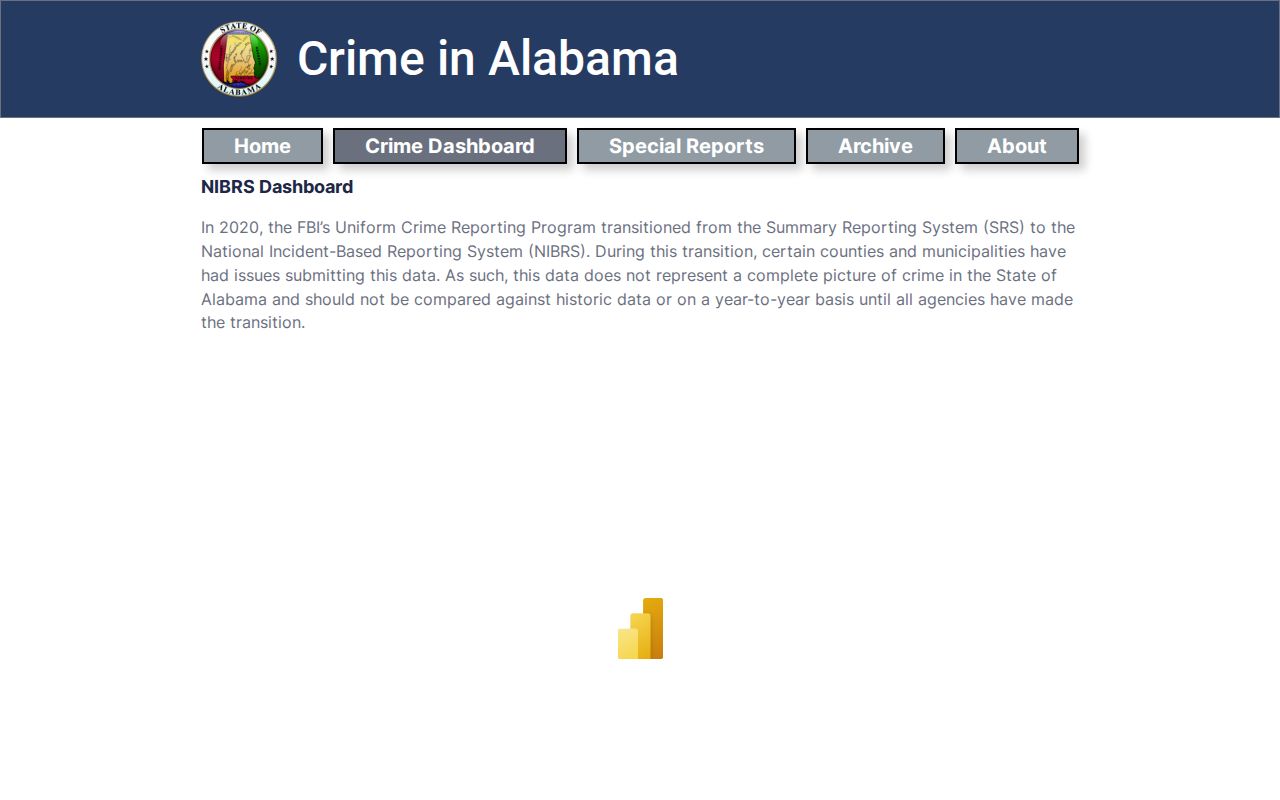
The dashboard controls provide statewide context, but those rows are not a count of unique people or convictions. One event can create more than one offense or report row.
ALEA’s official crime-data methodology warns that agency submissions were incomplete during the transition from summary reporting to NIBRS. Displays reflect reported data, and year-to-year comparisons are unsafe during the transition.
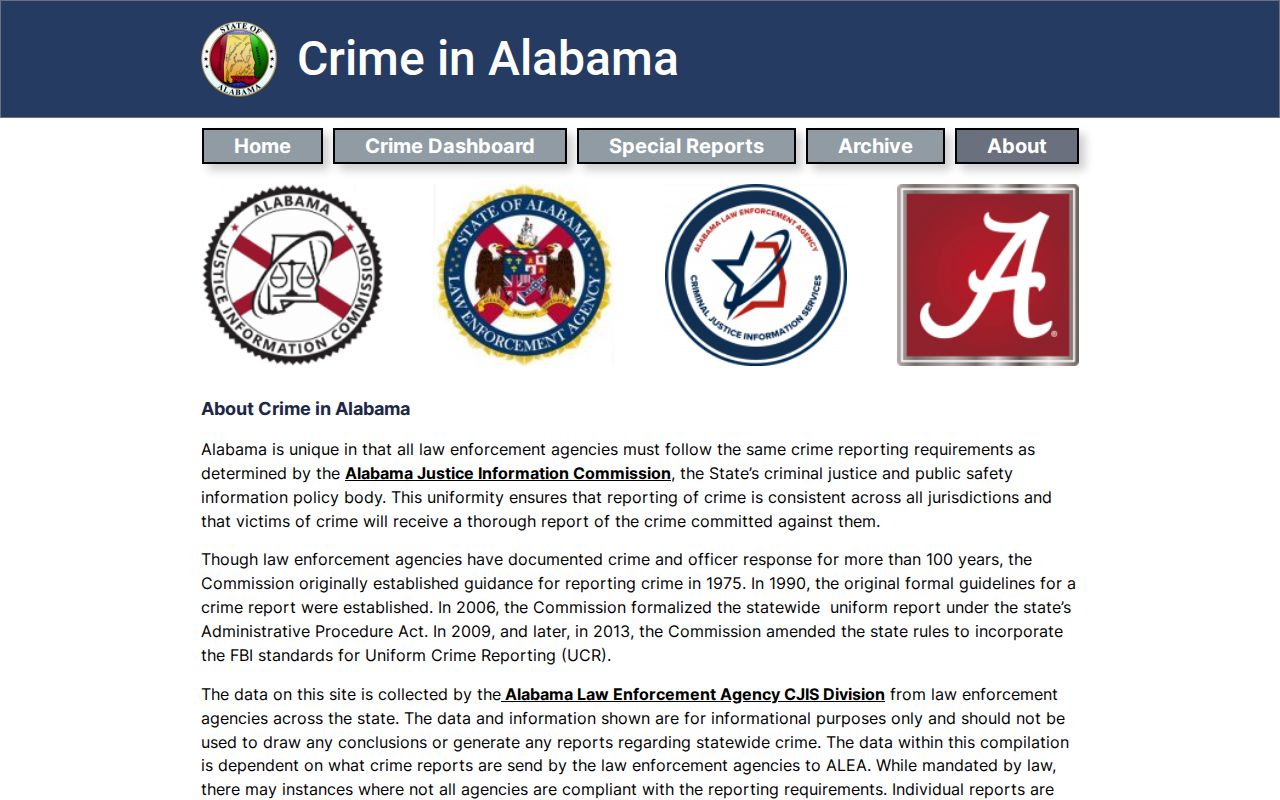
The warning keeps Alabama arrest statistics in their proper role: a view of submitted report rows, not a statewide booking list and not proof about any one person.
Note: NIBRS arrest rows measure submitted reports, not unique people, bookings, charges filed, or convictions.
Looking Up Arrests in Alabama
Alabama has no unrestricted public repository name search and no single live booking roster for all counties. A person can request their own ALEA criminal-history record through the official Alabama self-review channel with Form 46, fingerprints from an authorized law-enforcement agency with an FBI-issued ORI, photo identification, and a $25 fee. The separate Alabama Background Check system is restricted and should not be treated as a public people-search portal.
- Identify the likely arresting agency, county, city, date, and receiving jail.
- Use the official sheriff roster or call the jail for a current or recent booking.
- Open the directory of all 67 Alabama counties for local arrest logs, jail details, agency request routes, and court records.
- Check District, Circuit, or Municipal Court for the complaint, bond action, filed charge, and disposition.
- Request the arrest report from the exact creating agency with the event details and case number.
- Use ALEA’s fingerprint process for one’s own statewide CHRI, or ADOC Inmate Search only for current state-prison custody.
A recent booking may appear before a court case is filed. After release, a short roster window can close while the arresting agency and court retain their records. Search each source according to its role rather than expecting one Alabama arrest lookup to hold the complete event.
County Booking Interfaces in Alabama
County roster designs vary, but Alabama booking portals often allow searches for current confinement, recent admits, release date ranges, names, charges, and arresting agencies. One official county interface limits custom admission ranges to 31 days and separates current custody from release results. Its agency list also shows that ALEA, municipal, county, state, and federal officers can deliver people to the same jail.
The official representative county booking interface shows these tabs and controls.
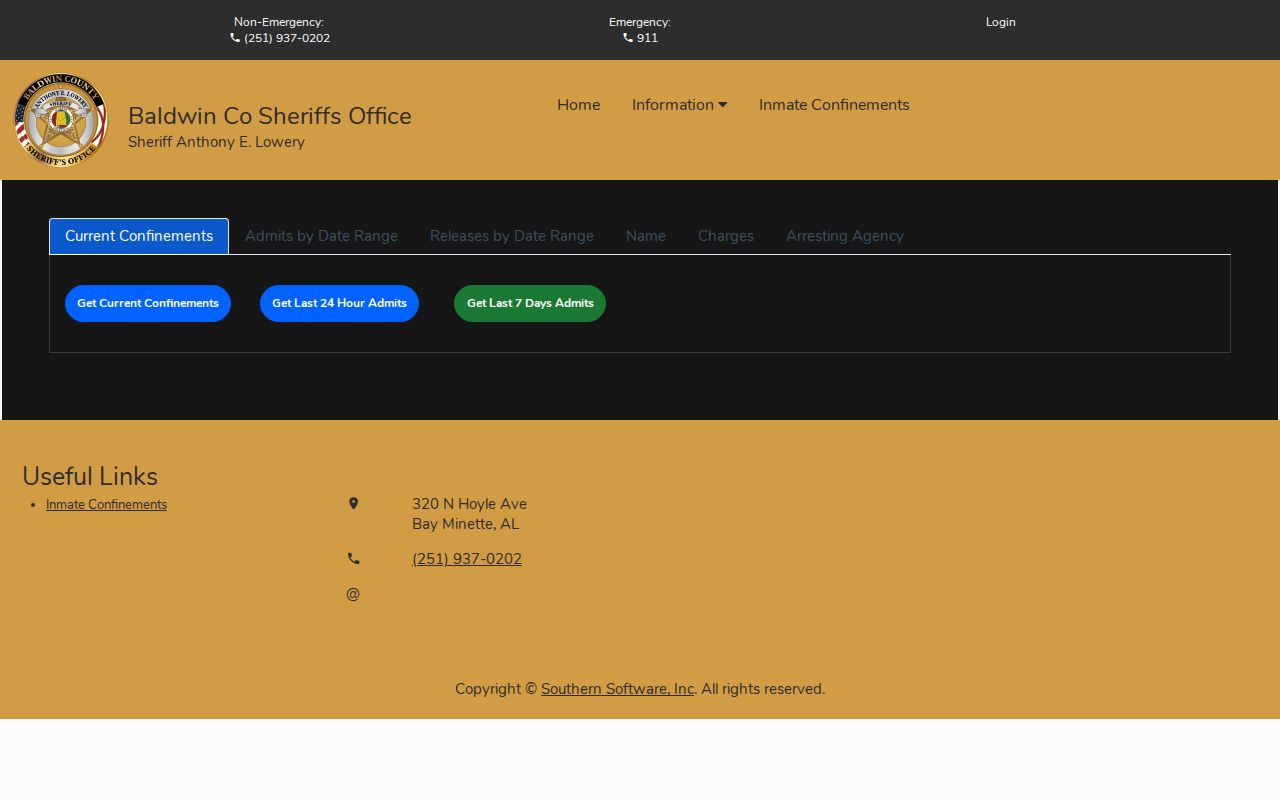
This layout illustrates the county pattern, not statewide coverage. Its roster reflects one corrections center and carries a local accuracy warning. Other counties may publish different windows or provide only a records contact.
No Alabama law located in the research guarantees online publication of every adult booking photo. A custodian can apply investigation, privacy, Youthful Offender, juvenile, and expungement limits. Never rely on a private mugshot site. Ask the official agency whether a lawful public copy exists.
Inside an Alabama Arrest Record
Alabama’s Uniform Arrest Report captures far more than a public jail roster. Rule 265-X-3-.05 provides for the reporting agency ORI, case number, state and federal identity numbers when assigned, aliases, physical description, arrest circumstances, each alleged charge, fingerprint status, release information, vehicles, and evidence. A public copy can redact protected identifiers, victims, minors, active investigative content, sealed material, and confidential juvenile or Youthful Offender data.
| Name & Identifiers | Name, aliases, date of birth, physical details, agency case number, and lawful identity numbers. |
|---|---|
| Arrest Date & Place | Date, time, location, jurisdiction context, and whether the arrest followed a warrant. |
| Arresting Agency | The office that made or reported the arrest, which can differ from the jail. |
| Charges at Booking | Alleged offenses, statute, felony or misdemeanor flag, and warrant details where present. |
| Booking & Photograph | Local intake identifier, custody date, and photo when lawfully released. |
| Bond & Release | Held, bail, released, transfer, bond, release date, and receiving-custody details. |
A roster does not normally hold the full officer narrative or later judgment. The agency report can contain circumstances absent from the jail screen. The clerk file can show an amended filed charge and final result. ALEA can connect fingerprint cycles across counties. Keep the dates and identifiers separate so fields from different events are not merged into a false master record.
Alabama Arrest Disposition Codes
The Alabama arrest form uses operational release terms that should not be confused with court outcomes. “Held” records continued custody. “Bail” reflects release through bail. “Released” records release without turning the person over to another agency. “TOT-LE” means turned over to another law-enforcement agency. “Other” captures a different documented arrest disposition.
- On view
- An arrest based on an officer’s direct observation or lawful on-view authority.
- On call
- An arrest recorded under the form’s call-based arrest category.
- Result of a warrant
- An arrest carried out under an existing warrant rather than a final court judgment.
- R84
- The disposition-report mechanism used to connect later court outcomes to the arrest cycle.
Police statuses such as active, inactive, closed, cleared by arrest, unfounded, or exceptional clearance describe investigation and reporting. “Cleared by arrest” does not mean convicted. Find the filed case and read its charge-level disposition to learn what the court decided.
Note: Transfer and release codes describe custody movement, while dismissal, acquittal, plea, verdict, and sentence belong to the court record.
Arrests vs Convictions in Alabama
An Alabama arrest is an accusation and custody event. A conviction is a court judgment following a guilty plea or verdict. The gap matters because the booked charge can be changed, rejected, dismissed, or resolved on another count. An arrest entry without its disposition cannot show guilt, and a bond amount cannot show the merits of a case.
| Arrest Record | Conviction Record | |
|---|---|---|
| Created by | Arresting agency and booking jail | Court judgment reported through official channels |
| What it proves | An arrest or custody event was recorded | Guilt was adjudged by plea or verdict |
| Best source | Creating agency, jail, and one’s own ALEA CHRI | Filing court and certified judgment |
| Relief route | Eligible charges may qualify under Chapter 27 | Conviction relief is narrower and fact-specific |
Note: An Alabama arrest with no disposition is not proof of guilt; confirm the result with the court that handled the charge.
The county case file is not the same as the statewide rap sheet. A criminal court case search can show how one prosecution ended. ALEA’s fingerprint-based personal review can reveal whether that outcome reached the compiled statewide record.
Alabama Arrest Expungement Routing
Alabama uses expungement as its main adult record-clearing term. Eligibility depends on the actual charge, outcome, waiting rule, and statutory exclusions. Non-conviction paths can include dismissal with prejudice, no-bill, acquittal, qualifying nolle prosequi, certain later dismissals, and approved diversion results. Limited conviction routes carry more conditions. A person should test the precise disposition under current Title 15, Chapter 27.
The petition goes to the criminal division of Circuit Court in the county where the charge was filed. The current Alabama expungement form catalog includes Form CR-65, which asks for the underlying case, one charge per petition, eligibility facts, all known record custodians, attachments, prior petitions, service, and a notarized signature. Certified arrest and court records help the order reach the arresting agency, jail, clerk, prosecutor, and ALEA.
After an order, check every source that held the Alabama arrest record. If an old entry persists, obtain a fresh ALEA self-review, contact the originating clerk, and provide the certified order to the agency showing the error. Juvenile and Youthful Offender records follow separate confidentiality laws. Expungement also does not authorize another person to obtain data that remains restricted.