
Checking Criminal History in Alabama
No single Alabama search answers every record question. A person reviewing their own fingerprint-linked state history starts with the Alabama Law Enforcement Agency, or ALEA. Someone tracing a filed prosecution uses Alabama Administrative Office of Courts trial records and the filing clerk. A recent booking belongs to a county or municipal jail, while a sentenced state prisoner appears through the Alabama Department of Corrections. The public sex offender registry is a separate notification system. Each source has its own scope.
Gather the full name, known aliases, date of birth, county, arresting agency, and any case, booking, warrant, or Alabama Institutional Serial number already available. Use identifiers only in the official system that asks for them. A common-name result is not identity proof. A blank result can mean the wrong court, a short roster window, restricted material, an archive gap, or delayed reporting.
- Define the question: statewide self-review, one case, recent custody, state prison, warrant, or registry status.
- Open the official system that owns that type of Alabama criminal record.
- Match identifiers and read the system's coverage limits before treating a result as relevant.
- Use the county directory for the arresting agency, jail, municipal court, or Circuit Clerk that created the original.
- Order certified court proof or a fingerprint-based ALEA review when accuracy must be resolved.
Note: An arrest entry, court case, repository rap sheet, and custody profile are related records, but none is a copy of another.
Alabama Form 46 Record Review
ALEA does not offer the general public an unrestricted name search of its repository. The public personal route is SBI Form 46 review. It ties the request to fingerprints and returns the requester's own Alabama Criminal History Record Information. The packet requires an FBI-approved applicant card or approved AFIS printout from an authorized law-enforcement agency with an FBI-issued ORI, a copy of accepted photo identification, a signed application, and payment.
The state charge is $25 by cashier's check or money order. Each extra copy requested with the packet is $5. ALEA directs applicants to mail the packet to its Criminal Records and Identification Unit or hand-deliver it at headquarters. The published minimum is four to five weeks after receipt. A local fingerprint counter may set a separate capture charge, so call first and confirm that it can return the correct card.
| Identity fields | Legal name, aliases, date of birth, physical descriptors, address, and identification details. |
|---|---|
| Required proof | Current accepted photo identification and fingerprint card or approved AFIS printout. |
| Signature route | Two witnesses or a notary, as the current form permits. |
| Correction route | Appendix A, the ALEA response, each disputed item, and proof from the arresting agency or court. |
Inside the Alabama Criminal History Repository
The Alabama Law Enforcement Agency repository sits within the State Bureau of Investigation's Criminal Justice Information Services Division. Its Criminal Records Identification Unit maintains fingerprint files and the computerized statewide criminal history. The Records Check Section handles lawful inquiries, the Criminal History Section works on record accuracy, and Automated Biometric Identification System staff process fingerprint images.
A local arrest begins the chain. The arresting agency creates the report, the jail records custody, and fingerprint-supported data moves to ALEA. District, Circuit, and municipal courts create a separate prosecution stream. Qualifying dispositions should return to the repository and match the arrest cycle. That process makes the ALEA rap sheet a multi-county compilation, not the original police narrative or complete court file.
Access is controlled. Form 46 is for one's own history. The Alabama Background Check system is a gated subscriber service for qualifying access, not a public people-search portal. Name-based matching can produce false matches or miss history held under other identifiers. Fingerprints remain the stronger identity key.
When Alabama Criminal History Has Gaps
Repository technology cannot create a record that an originating agency never sent. ALEA's own annual reporting showed that some expungement orders could not be completed because the arresting agency had not submitted the fingerprint card. A rejected card, a delayed court report, or an unmatched disposition can also leave the state history out of step with the filing clerk.
For a wrong or missing outcome, first obtain a certified case action or order from the court that controls the source. Then use Form 46 Appendix A to identify the charge, date, agency or court, disputed text, proposed correction, and supporting proof. ALEA contacts the originator before it changes the state record. A challenge made within one year of the response has no separate fee stated. After one year, the process begins with a new review.
Record correction: Administrative Rule 265-X-2-.03 allows review and challenge of Alabama CHRI, while expungement requires a separate Circuit Court order under Title 15, Chapter 27.
Note: A corrected court file does not always update every linked system at once, so check both the clerk and a fresh ALEA response.
Alabama Statewide Record Systems
Alabama divides records by function. Just One Look offers paid access to Circuit and District trial-court case information. ADOC Inmate Search covers people currently incarcerated by the state prison system. ALEA publishes the qualifying public subset of locally verified sex offender registrations. ABPP posts current-year parole decisions but has no public master search for all probationers. None replaces a county jail roster or municipal court.
| System | What It Holds | Run By |
|---|---|---|
| ALEA Form 46 review | The requester's fingerprint-linked Alabama CHRI | ALEA CJIS |
| Alacourt Access / Just One Look | Paid Circuit and District trial-case detail | Alabama Administrative Office of Courts |
| ADOC Inmate Search | Current state-prison custody and sentence fields | Alabama Department of Corrections |
| Alabama Sex Offender Registry | Public notification profiles authorized by law | ALEA CJIS Sex Offender Registry Unit |
| ABPP parole results | Current public parole hearing outcomes | Alabama Bureau of Pardons and Paroles |
Each statewide product has a hard boundary. Use the filing county for certified case documents, the booking county for a jail event, and the creating police agency for an incident narrative.
Alabama Custody Records Split Three Ways
County jails, ADOC prisons, and federal prisons are distinct. County jails usually hold recent arrestees, pretrial detainees, people awaiting transfer, and local sentences. Those records remain sheriff by sheriff. ADOC holds sentenced state prisoners after transfer. The Bureau of Prisons handles federal custody. Search the system tied to the legal custodian, not merely the place where an arrest began.
The Alabama Department of Corrections home page shows the statewide prison context captured below.

That state system is separate from all 67 local jail channels. ADOC Inmate Search accepts an exact six-digit AIS number or first and last name, caps results at 50, and covers current ADOC incarceration only. It does not provide a released-person history, county detainees, federal prisoners, or Youthful Offender results.
| Custody Question | Correct Alabama Channel | Main Limit |
|---|---|---|
| Recently booked or held locally | County sheriff or municipal jail | Roster windows and fields vary |
| Currently in state prison | ADOC Inmate Search | Current custody only |
| Federal sentence or custody | Bureau of Prisons locator | Not state or county custody |
Note: An ADOC minimum release or parole date can change and does not promise release on that date.
Types of Alabama Criminal Records
An Alabama criminal record can describe the event, custody, prosecution, compiled history, supervision, or public notification. The label matters because each product is made by a different office and changes at a different time. Read it for the purpose its custodian created it to serve.
- Arrest and booking records begin with the arresting agency and receiving jail and do not prove guilt.
- Criminal court case files track filed charges, action summaries, rulings, judgment, sentence, and financial entries.
- Repository rap sheets compile fingerprint-linked arrest cycles and reported outcomes across Alabama counties.
- Warrants can sit with a sheriff, District or Circuit Court, or municipal court, subject to access limits.
- Custody and supervision records are divided among county jails, ADOC, sentencing courts, and ABPP.
- Registry records publish the subset required for public notice, not a full criminal history.
- CHRI
- Identifiable Alabama criminal-history information tied to arrests, charges, dispositions, sentencing, supervision, and release.
- Disposition
- The recorded outcome or status of a charge or case.
- SID
- The Alabama identification number assigned through state fingerprint processing.
- Case action summary
- The court's dated sequence of filings, settings, rulings, and outcomes.
Keep the source label attached when comparing Alabama records. A booking charge can change before filing, and a repository disposition can lag behind the clerk's judgment.
Alabama Warrant Records Stay Local
Alabama has no verified public statewide index of every arrest warrant, bench warrant, capias, or sealed warrant. ALEA's Fugitive Search is a curated public-awareness list, not a certificate that no warrant exists. A bench warrant may appear in a District, Circuit, or municipal docket, and a city matter can sit outside the county search a reader tried.
Start with the likely county and court. Check an official sheriff warrant list or call its warrant unit, read the filed case for terms such as capias or failure to appear, and contact the municipal clerk separately when a city matter is possible. Confirm status with the issuing clerk. If resolving one's own warrant, follow counsel or court directions because an office visit may result in arrest.
Note: Active, sealed, juvenile, and tactical warrant material may stay restricted even when another part of the case is public.
Alabama Probation and Parole Records
Adult probation and parole supervision is state-run through the Alabama Bureau of Pardons and Paroles. ABPP reports three field divisions, 14 districts, and more than 60 field offices. There is no verified public all-probationer name search. The sentencing court holds the probation judgment and revocation docket, while the correct ABPP field office handles appropriate supervision questions.
The official ABPP field-office directory routes Alabama supervision questions by county.
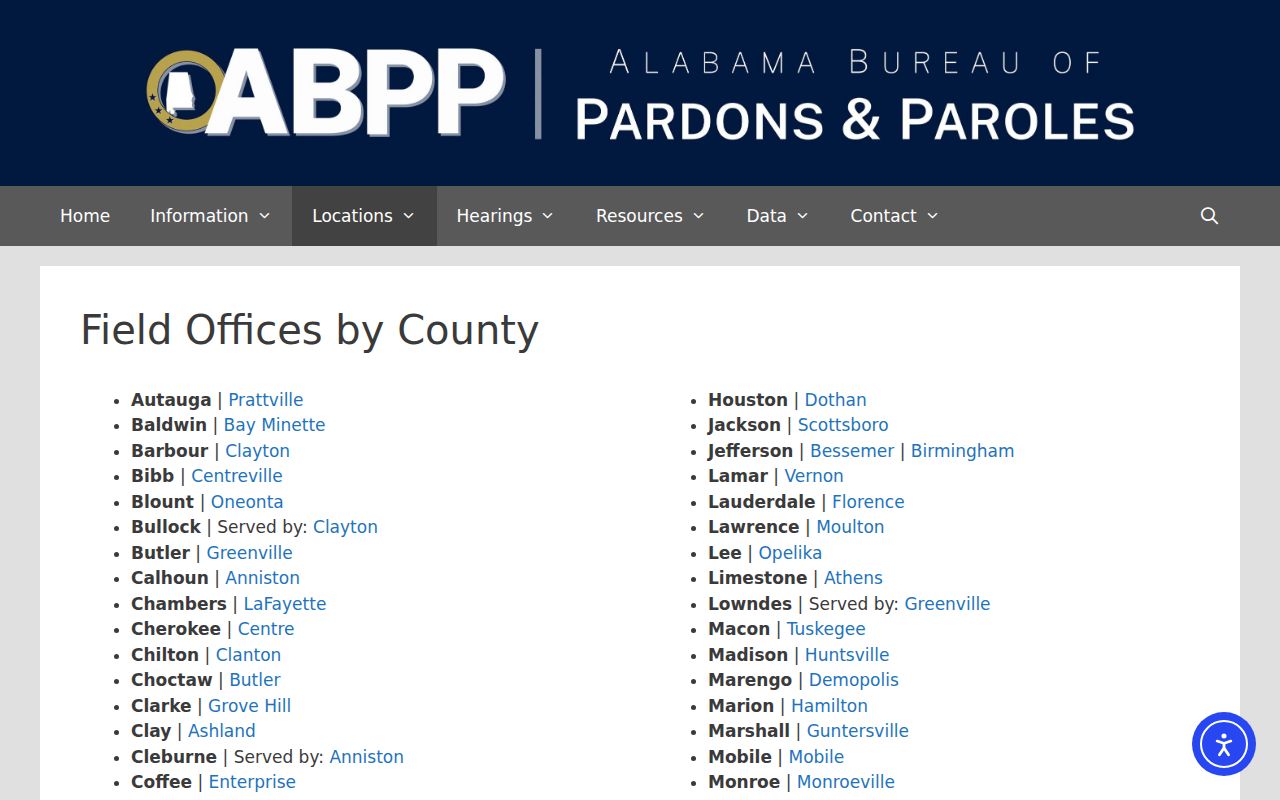
The county route matters because community-corrections programs are local alternatives, not the ordinary statewide probation system.
ABPP also publishes current-year parole results with the hearing date, AIS, name, medical flag, result, and counties of conviction.
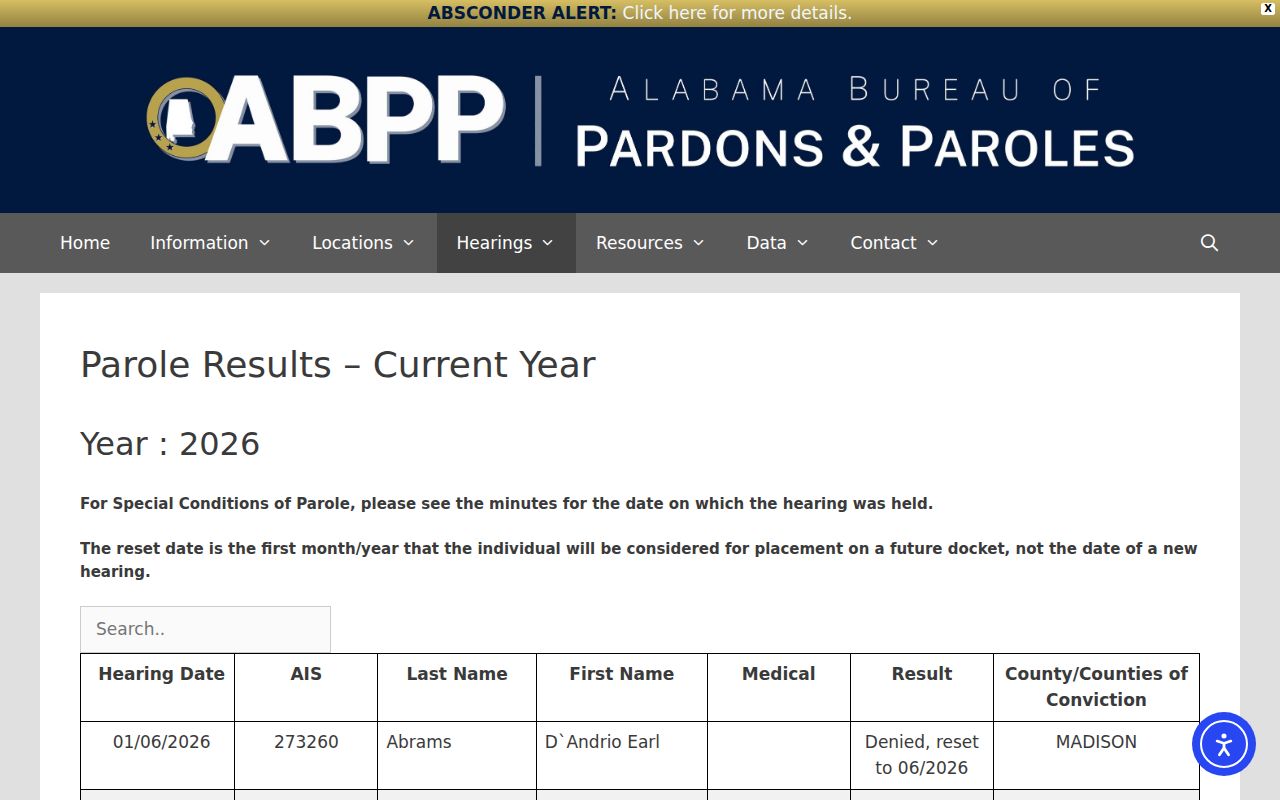
A reset date is the first possible future docket month and year, not a promised hearing or release. ADOC profile dates can also change.
Alabama Public Access Laws
The Alabama Public Records Law gives Alabama citizens a baseline right to inspect public writings, but specific restrictions still control CHRI, court privacy, juvenile files, Youthful Offender material, and active investigations. The 2024 reform added standard and time-intensive request categories, estimates, prepayment rules, and response procedures. A request must go to the office that created or keeps the record.
Key Alabama laws:
Ala. Code §36-12-40 supplies the baseline right to inspect and copy public writings.
Ala. Admin. Code r. 265-X-2-.02 controls lawful CHRI dissemination and does not create an open public name search.
Ala. Code §41-9-601 penalizes false-pretense acquisition, unauthorized communication, or falsification of criminal-offender information.
Court Record Rule 401 preserves free public Circuit and District electronic viewing at the clerk counter while remote access may be paid.
Ala. Code §15-19-7 restricts Youthful Offender fingerprints, photographs, and records.
Remote convenience is not the same as legal access. A missing online image may still be open at the clerk, while a confidential record stays restricted even after a portal payment.
Note: Paying for remote court access does not make a sealed or otherwise confidential Alabama record public.
Alabama Police and Crash Records
There is no statewide pool of every Alabama incident narrative. Request a police report from the city department, sheriff, campus agency, or ALEA unit that created it. Name the event date, location, agency case number, and desired format. Protected victim data, juvenile information, medical details, and active investigative material can be redacted or withheld.
Crash reports have a distinct ALEA channel. The official crash report page states a $15 charge and gives online and Driver License Office ordering routes.
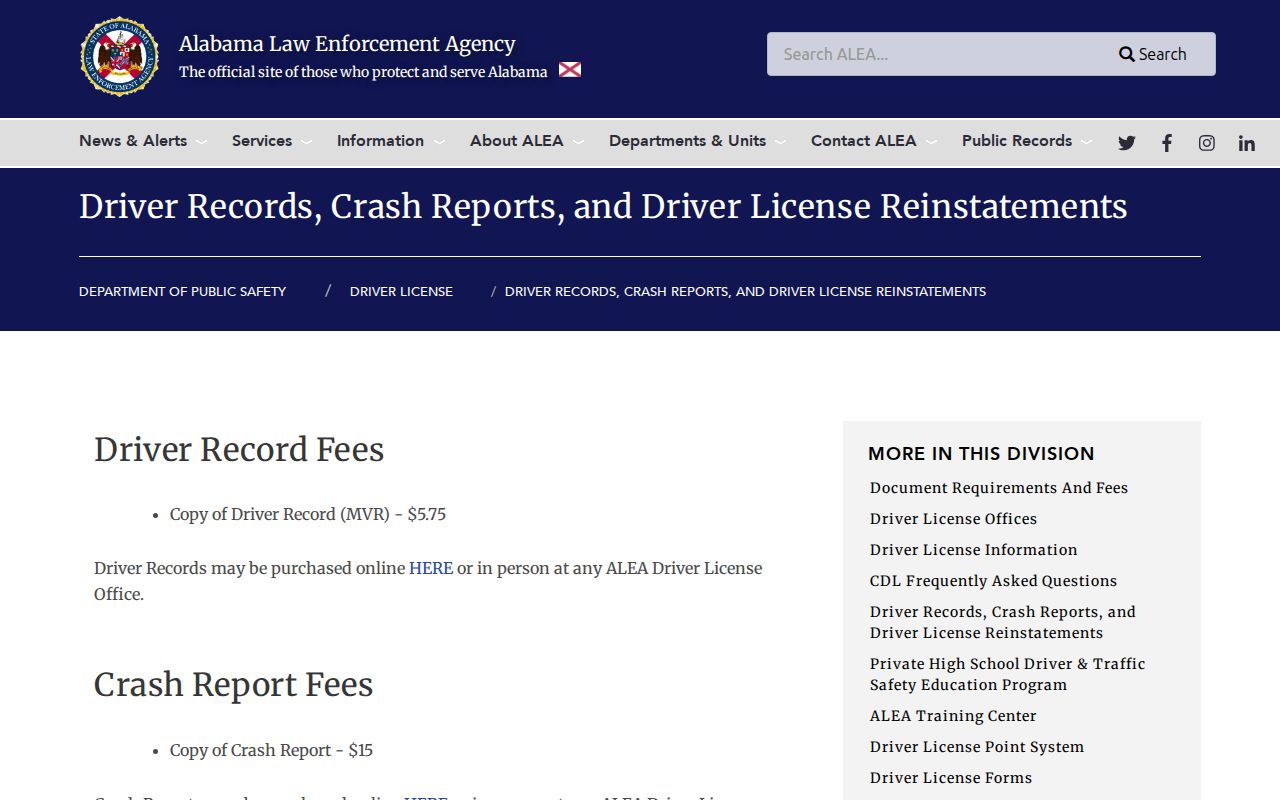
Release is limited by Ala. Code §32-10-7 to listed eligible recipients. The mail form asks for requester information, driver and crash details, county, date, location, and any fatality name. A crash report is not an open statewide people search.
Alabama Criminal Charge Classes
Alabama defines a felony as an offense authorizing more than one year of imprisonment and a misdemeanor as no more than one year. Class labels help locate the likely trial court, but offense-specific rules, weapon enhancements, and habitual-offender provisions can change a sentence. Circuit Court is the primary felony court. District and municipal courts handle lower-level matters within their jurisdiction.
| Class | Baseline Imprisonment | Fine Cap |
|---|---|---|
| Class A felony | Life or 10 to 99 years | $60,000 |
| Class B felony | 2 to 20 years | $30,000 |
| Class C felony | 1 year 1 day to 10 years | $15,000 |
| Class D felony | 1 year 1 day to 5 years | $7,500 |
| Class A misdemeanor | Up to 1 year | $6,000 |
| Class B misdemeanor | Up to 6 months | $3,000 |
| Class C misdemeanor | Up to 3 months | $500 |
The filed charge can differ from the booking label. Read the court judgment before treating any arrest class as the final outcome.
Alabama Expungement Starts in Court
Alabama's main adult clearing remedy is expungement under Title 15, Chapter 27. The petition goes to the criminal division of Circuit Court in the county where the charge was filed. Eligibility depends on the charge, outcome, completion facts, waiting rule, and exclusions. A dismissal does not create one universal deadline. Certain misdemeanor and felony paths exist, while violent, sex, moral-turpitude, and other listed offenses face statutory limits.
The statewide Alabama expungement forms catalog provides the CR-65 petition and hardship materials.
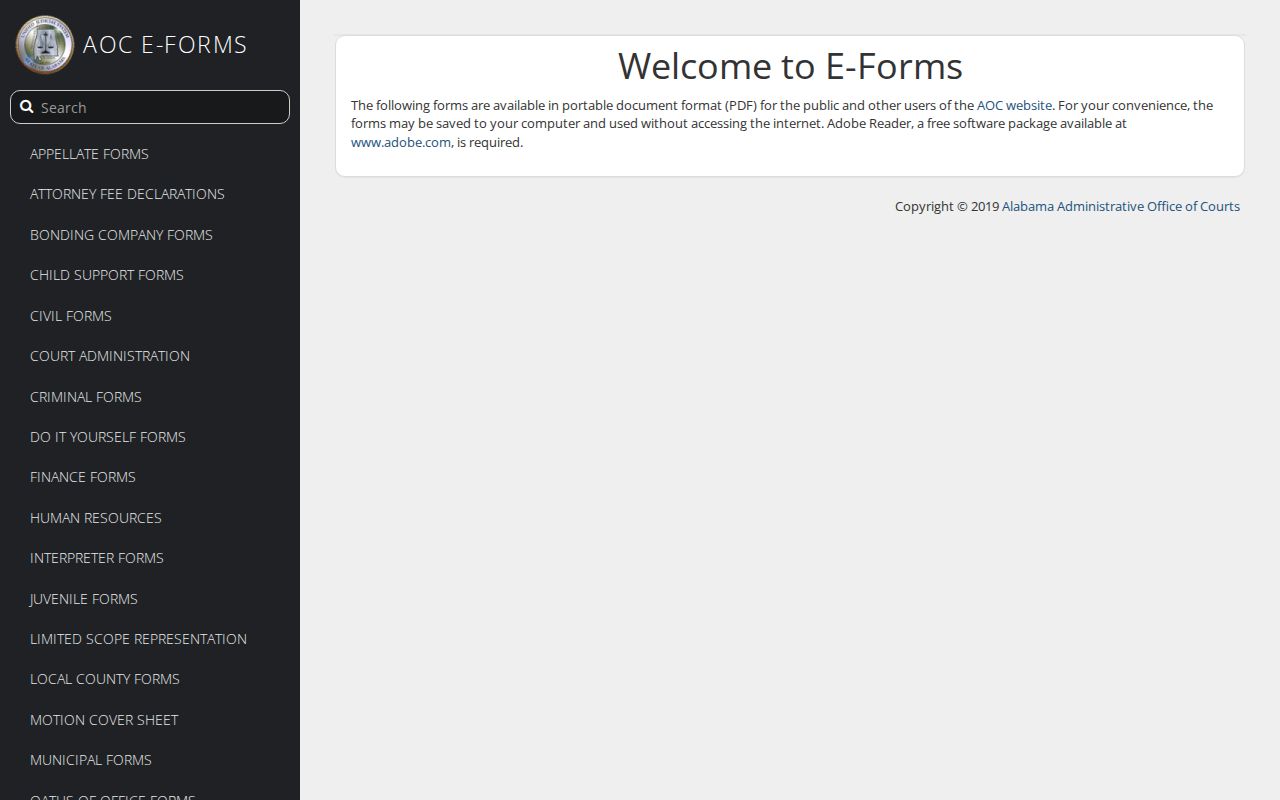
The packet commonly needs certified arrest and disposition records, a certified ALEA history, the petition, service details, and the $500 administrative filing fee or a hardship request. CR-65 asks for every known record custodian because an omitted agency can lead to an incomplete order.
- Confirm the current statutory path for the exact charge, outcome, and date.
- Get certified booking and disposition proof plus an ALEA record review.
- File CR-65 in the Circuit Court county where the charge was filed and serve the required prosecutor.
- After an order, verify the clerk, arresting agency, jail, and ALEA record separately.
Note: Juvenile confidentiality and Youthful Offender restrictions are separate from adult Chapter 27 expungement.
Criminal Records by County in Alabama
Alabama arrests, bookings, police reports, warrants, and original case files begin with local custodians. The state's largest metro counties also have multiple municipal systems, court divisions, or large jail networks. Each of Alabama's 67 county sites routes to the proper sheriff, clerk, jail, and city channel. These featured counties are useful starting points for the highest-volume local systems.
Jefferson County
Birmingham · Alabama's largest county and a two-division court system
Mobile County
Mobile · Gulf Coast jail, court, city, and federal record channels
Madison County
Huntsville · A fast-growing north Alabama court and jail hub
Baldwin County
Bay Minette · Coastal county with many separate city record sources
Montgomery County
Montgomery · County records beside distinct statewide headquarters
Shelby County
Columbiana · Metro county with many municipal courts and agencies
Tuscaloosa County
Tuscaloosa · County, city, university, and state record sources
Lee County
Opelika · Auburn-Opelika county, city, campus, and court systems
Browse the full directory of all 67 Alabama counties to open the criminal records site for any county.